Followers

About Me

My photo
jaipur, rajasthan, India
retired Army Colonel

Sunday, December 1, 2019

BANDHAVGARH BEYOND TIGERS


‘We travel not to escape life, but for life not to escape us’

 – Robyn Yong


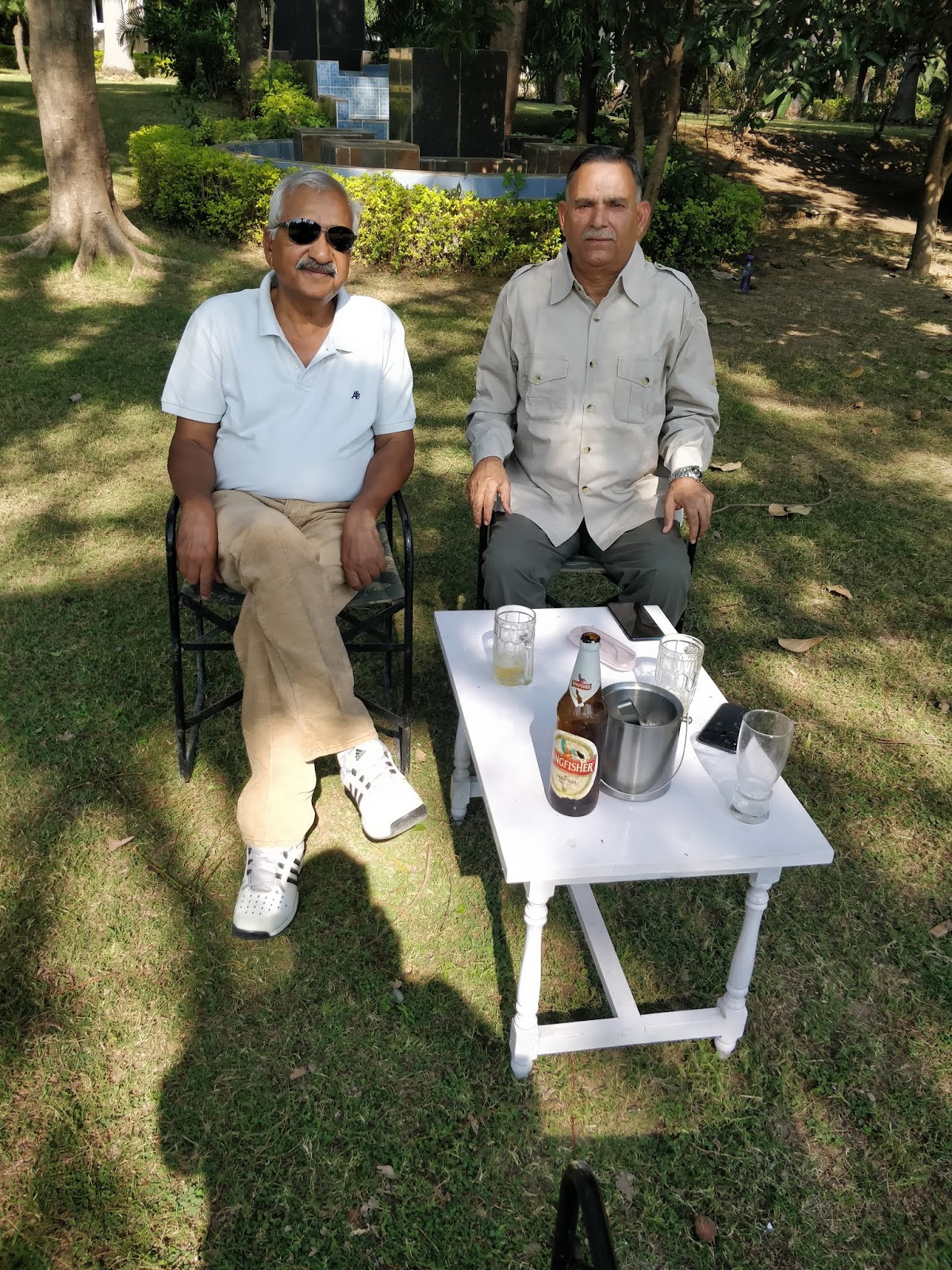
Now, into seventh decade of life, I find myself yearning for more productive and soul filling, travels. Indulgence into run of the mill tourism, attracts me no more now. Travel is a nice getaway as it up-sticks us from the grooves of our daily mundane chores, and releases us free to make fresh connects within and without. It is a great feeling of being liberated, like switching over to ‘Do Not Disturb’ mode. We, four childhood friends homed on to Bandhavgarh National Park, for a sojourn with its luring deciduous forest.
All of us Boarded Dayodaya Express at Jaipur, to take us to Katani junction, the railhead for Bandhavgarh. Dayodaya (दयोदय) was a strange word to me, and it took me a while to understand its meaning. I learnt, it is concept, and a movement by one Jain muni, Vidyasagar about the human compassion towards animals. May be the Indian Railway thought well to name this train so, taking travellers to wildlife sanctuaries and parks of Madhya Pradesh.
To know the actual India, and with no pretence, a long rail journey does real good.  The real India, is on the railway platforms and the public conduct is despicable and disgusting. The coach we travelled in was, unmistakably on a rather long extended service, with no Supreme Court to intervene, as in case of Qamar Javed Bajwa, the Pakistani Army Chief. Despite the visible series of repairs and patch work, it had still worsened into a bone rattler. Though, the coach was well kept otherwise and well served but the blankets they issued for the night, stank. All these irritants miserably failed to dampen our spirits, and the enthusiasm to travel to Bandhavgarh was uncork-able. Soon, we four were chatting, recollecting schooldays, old friends, and talking non stop with sporadic crackles, unmindful of the strange looks from co passengers. Our Absolute (spirit) with freshly cut lime &  crushed green chillies, went well camouflaged. The pot lunch was sumptuously filling, and our titters faded as we dosed of late, well passed midnight.
Soon, we were on the road loaded in Innova driving to Bandhavgarh, Tala to be precise. The deciduous forests along side, made the single road look like a tunnel. The whole environment was so invigorating, we rolled the panes of car windows down to gasp as much fresh air. Our hosts: The Tiger Den, run by Mr Gyanendra Tripathi, gave us opened arms reception. The resort is tastefully laid out, landscaped with exotic plantation. The bamboo groves, Champa, Molsari,  Kadam, Palash etc, standing tall and were enough to make us fall in love with the place. Here we will be spending nextt threed  and the very thought was kindling excitement inside us. The cottages were neat, clean and well furnished.


It was Safari Time at 2.30 PM.

We all dressed up like cowboys, donning shades, mounted the Maruti Gypsy, and our सारथी was Sh.Raju Singh, a veteran driver of Bandhavgarh Park, for 25 years. He knew the sanctuary like back of his palm and Tigers by their first names including lineage. Our rattled backs, after Dayodaya Express, found no respite with Raju Singh Ji’s Gypsy. Himmat Singh, one of the  foursome had tough time in the rear most seat. I had comfortable time sitting in front, courtesy the rest. They knew my handicap.


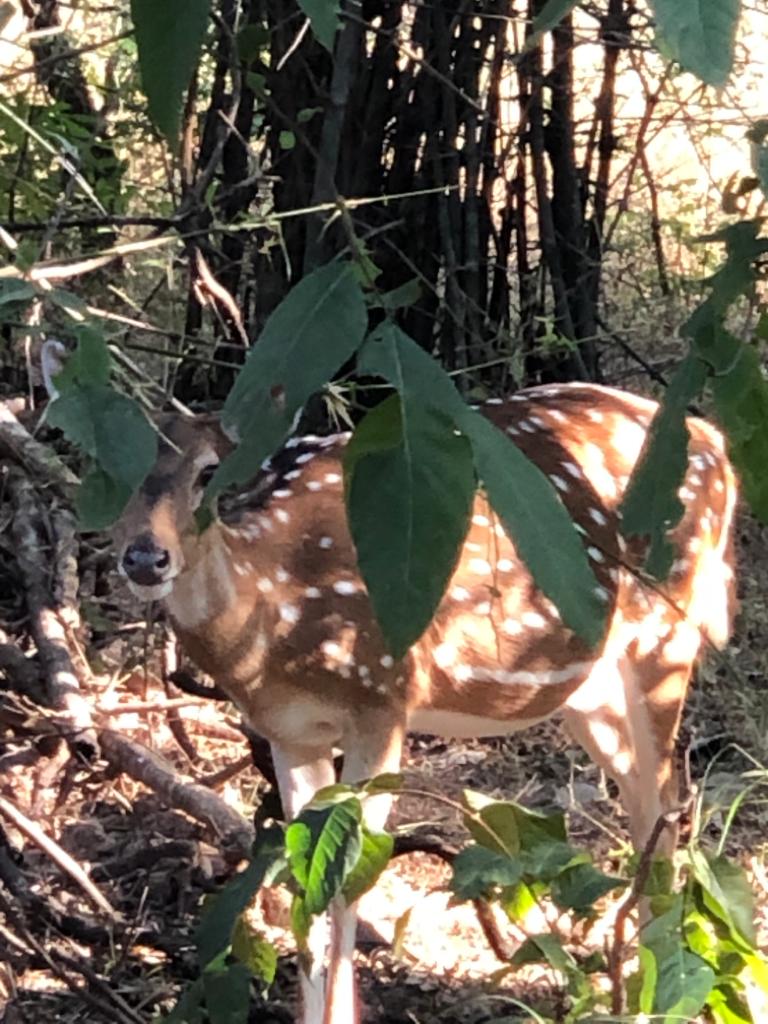
Bandhavgarh, is mainly a Sal forest, a tree that provided timber for railway sleepers, till the concrete ones replaced these recently. The locals say nothing goes wrong with the wood for 300 years, and in their dialect “ सौ साल खड़ी, सौ साल पड़ी और सौ साल ना सड़ी। It is a tough wood. We soon started seeing wild life, and the very first were elephants housed in their camps. It was wonderful sight of a baby elephant and mother cuddling with her trunk. Soon, we crossed a herd of spotted deer grazing, then
appeared wild boars, crossing our track. Jungle babblers, and many birds we don’t know names of,were cooing and chirping filling the air with such delight.


And then our guide drew our attention to the callings by different animals. It was monkey and Chital repeating the call with enough desperation. I was experiencing it for the first time. Padam Singh, a veteran of Forest services, explained us the calling by animals and how one can track the movement of the predators. Our guide, soon changed his guess from Tiger in proximity, to Leopard because the Chital’s bleating was not crying enough. It was getting dark, and there was no sighting of Tiger as yet.  We returned to our camp empty and disappointed. Fortunately, Padam Singh’s friend and a colleague from Forest Dept, Mr Narendra Singh Parihar came down to meet him. He promised us
Tiger sighting next morning.

We were up at five, made second attempt and this time through a different zone called Magadhi. Early morning chill, and drive in open Gypsy was bothering us when, we were pleasantly surprised by our hosts who handed over us soft blankets to cover ourselves. It was like God sent. As we drove into forest through the misty morning, we were greeted by a herd of Bisons grazing not any far from us. What a massive beast it is! Each shouldn’t be weighing less than 6 to 700 Kgs. Our guide, indicated two alpha males, who would be around 1000 kgs. They both had locked their horns, and may be claiming mating rights in the herd. We took some snaps.


As we moved deeper into the jungle, Kamlesh our guide spotted the pug marks of Tiger. He further asserted, these are of a Tigress and other smaller ones of her three cubs. He knew, that she is Dotty and just finished her night patrol, along with her cubs. Dotty, with her young ones now in a process to settle down for the day, he further stressed. I asked, why she is called Dotty? Kamlesh explained that the Tigress has a ‘D’ looking spot on her forehead, and that’s how the name. And, there is another Tigress who is named Spotty, on similar lines. The pug marks were seen vanishing into the woods, and we all knew where she has taken a morning break. There was continuous calling, and the presence of Tigress was eminent. But, she wouldn’t just show up. Our patience gave up. We decided to drive upto the refreshment point and have our breakfast, in the meantime. The hawkers, there were making hot pakoras, steaming Maggi, and ginger tea. I didn’t touch packed Breakfast from Hotel. As, we were getting done with our last sips of hot tea, there was sudden alert sounded for the Tiger, who was greedily eyeing for some cows, strayed grazing into the buffer. All the tourists jumped into Gypsies, and everyone just broke loose, zipping towards the sought after spot.


And, lo behold. The Tiger was in his ambush, tactically sited. Unnerved by huge gallery, the regal predator was sitting on the fringes, well camouflaged. His demeanour was kingly and we all watched him with widow eyes. Our wait was over. After, granting us a great audience, he quietly walked to his next bound for an intended hunt. As he gracefully moved, his gender was reconfirmed and “ He is Bhamera’s son” said Kamlesh. What a name the royal beast had! I enquired further, and unfolded the story. There was Tiger who had once strayed into nearby village, called Bhamera. He got his name. What we saw was his son. Seems so strange! No?

Our mission was nearly over once the Tiger had shown up. For all those wildlife enthusiasts, who venture into various sanctuaries and parks, I would leave a thought behind. It is the forest and it’s environ that has to be savoured and felt by our souls. Focusing on Tiger sighting can rob you of the small pleasures of watching the flora and fauna, the cooing and chirping of the birds, fluttering of jungle fowls, that innocent gaze by antelopes or may be monkeys jumping around. The moist air of jungle has soul filling scent and earthly whiffs that invigorates your nostrils and lungs. The quietness and serenity of jungle is treasure we miss in cities. Let’s not miss woods for the trees, or shall we say Tiger?

Part II


A visit to Bandhavgarh would be incomplete without having shopped and eaten at Malaya, a boutique cum café run by an elderly lady Ms Neelam. Her shop be better called as an Art Gallery. She relocated herself away from the hustle bustle of Ahmedabad city, for her sheer love for living in smaller places, close to nature. The lady has rightly thought of running such a delightful corner in a rustic rural, Tala. Ms Neelam has a passion of collecting art & craft works from pan India, specially the tribal work. She singlehandedly drives her Maruti Gypsy, and detests national highways. Venturing deep into the countrysides, she looks for dying arts and skills of our Indian tribes, reach out to artists, crafts(wo)men and does her best to preserve these. Each item in her shop is carefully selected, handpicked and needless to say priceless. Himmat Singh and I bought a few souvenir, but  God sent,  through her, was my favourite fresh beans, French Press filtered Coffee, with a delicious banana cake (egg free), that too complimentary. Knowing her was great pleasure, and my blog would have been equally incomplete without mentioning The Malaya.


Friday, October 4, 2019

Death of Mainstream Politics in J&K


The Ceasefire line of Indo-Pak war in 1947-48 was also de facto, divided the polity of J&K on lines of secularism. On its Eastern side the J&K polity, enjoyed the confidence of an emerging  progressive leader, Mohammad Sheikh Abdullah. He had changed name of his political party from Muslim Conference to National Conference. Nearing independence, the friendship between Nehru and Sheikh grew stronger and was forged more on ideology and mutual admiration. While, the integration of J&K into union of India under the provisions of article 370 had begun well, the demand of plebiscite didn’t die as wished, and anticipated by Nehru. The trust between Nehru and Sheikh started eroding as both were testing waters to encroach upon more and more political advantage. Nehru, had signalled in his Calcutta speech(1948), that Plebiscite may be difficult due to changed circumstances, and later subsequently enforced CAG jurisdiction over J&K, and merged its state forces with Indian Army much against the wishes of Sheikh. This led to mistrust and doubt in the mind of Sheikh, if his decision of supporting Instrument of Accession, was right. He started exploring possibilities to have an independent Kashmir, and his liaison with Ayub Khan, US envoys suggested that.
What came to be known as Kashmir Conspiracy was hatched. Sheikh was arrested and put behind bars in a jiffy. He didn’t realise what had hit him. This gave a backhand blow on Kashmiri mainstream politics, and seeds of separatism were sown right in.
Then, began the era of making and unmaking of Jammu and Kashmir Government through rigging elections, and manipulating politics of the state. The mainstream political leadership learnt the art of doing a tightrope walking, keeping the separatists and Delhi, both in good humour. Winning public support was of no consequence. The separatists had their militant wing going with the aid of Pakistan, and resorted to radicalisation through jihadi money to keep fuelling the  insurgency. The mainstream politicians had to fine tune the violence, separatists voices and Delhi's cash flow, there in lied the art of living. There was no slot for common Kashmiri to share political space and chip in to build its future. As a result these, manipulators swelled financially and had their coffers full.
The real leadership of Kashmir that had believed in joining secular, socialist India, and with a greater autonomy, while discarding the Pakistan option being regressive, had no other choice but to fade away or join separatists. The Delhi sponsored and groomed stooges, represented mainstream politics of Kashmir but this was sheer pretence, and fake. It had no future. In Hindi a saying goes, jhoot ke paanv nahin hotey. The message from Center was loud and clear that Government in state would represent Delhi, and people of Kashmir do not matter.
 A new strategy was unrolled by Delhi on 5th August 2019, as a Kashmir resolution formula. The State was reorganised into two Union Territories with severely curtailed legislative powers. The idea is to strengthen the local bodies and empowering  people at grassroots levels on one hand, and dismantle the helm of mainstream leadership on the other. Should it work or not? This current speculation is puzzling Kashmir observers now. Rekha Chowdhary in 'The Wire' says :   “By denigrating mainstream politics in Kashmir, the Modi government at the Centre has created a dangerous vacuum, reversing the gains of the past couple of decades.”
The empowerment of Panchayats in Kashmir is a noble idea and should work with people handling their own affairs of development and governance, leaving the separatist agenda for state leadership to conduct. And this has been already decimated smartly. Even the Hurriyat shall meet the similar fate.
Honestly speaking, mainstream politicians have failed the people of Kashmir by conspiring with Delhi, match-fixing with Separatists/Militants,  and conniving with ISI. It’s good that vitiated leadership of Kashmir is dispatched home and new crop of leaders to build Kashmir for future is ushered in. It’s not going to be straight walk but would need sustain effort and support from Delhi to de- radicalise, and heal the wounded hearts of alienated as well angered Kashmiris.
It may, still be premature to mourn the death of mainstream leadership in J&K, and wait for the new Kashmir to shape. Possibility of moments of rejoice shouldn’t be discounted.

Sunday, June 2, 2019


Ladakh Trip.


My fascination for Pangyong Tso (Lake) had started growing longtime back (yr 2003-4), when we, military intelligence staff officers, at Army’s Northern Command Headquarters, would regularly collate the Chinese intrusions in Ladakh.  The forward troops used to send us such beautiful visuals of this amazing lake, as part of the Situation Reports; and these would lure me to the marrow. Since, then I harboured the desire, to be there one day, and physically feel the very vim, this wonderful creation of nature invigorates. Apparently, God has a
timetable for all of us, and my visit to Pangyong Tso was to come now, so much later. It’s another piece of cake that at sixty(+) years my physical strengths would prove inadequate, to luxuriate this wonderful gifts of the nature, and my much cherished desire. Yet, it was an lifetime experience.

We, four boarding school old boys, regardless of our ripened age, decided to take our maiden trip to Ladakh, that too as singles (liberated from wives).


 The excitementw obvious, and I during
planning of the itinerary had put my foot down, saying: “Visit to Pangyong Tso is non negotiable

 Ladakh historically, I learnt has been a melting pot of many cultures, evolving into the finest traditions of peace and spirituality. Shamanism, Buddhism, Islam, Christianity and Hinduism are some of the many ingredients, of an entrancing recipe, that the pot churns out placidly. My friend Zora Nawang Regzin, a very tall local political leader, says, to our pleasant surprise that Buddhism came to Ladakh via Kashmir, which was at one time great Buddhist learning centre. Buddhism, in Ladakh he adds, is a blend of Shamanism, unlike what is being practiced in Japan or elsewhere. As we set out to see Leh, former capital of Ladakh kingdom, and its surroundings, Shri Patthar Sahib Gurudwara was one high point.
Guru Nanak Dev had meditated here, on the banks of River Indus and held on to a huge rock hurled at him by the demon.


As Zanskar river joins Indus only few miles away from here, a spiritual confluence of Buddha and Nanak spurns palpable positive synergy in the environment. We were fed by the langar of Baba(Guru Nanak) for the lunch, and it was simply soul filling.

Stenzin, a cute Ladakhi, was our driver cum guide,  and next morning, we four set out to explore Nubra Valley, across Khardung La(pass). A small tip for the travellers to Ladakh, hire Mahendra’s Xylo and not Innova, because of road clearance. It is a perfect car for mountains and quite spacious too. Climbing along the winding road, chasing contours of barren mountains, was very exciting, specially for our civilian friends who were venturing into such altitudes for the first time. I realised as we grow old we are conditioned to all kind of motion sickness, and may be that it troubles only kids. We four were all happy and chatting, in a child like propensity. As the altitude increased, we faced some kind of breathlessness. Thanks to the advisory by Brig Jha, the hand held oxygen cylinders came handy. The puffs started. We, got bumped into Army convoy and over spent our time in crossing Khardung La, but finally it was such a relief to climb down from 18379 feet. Soon, we were driving along breathtaking Nubra valley. It is flanked on both sides by towering rocky mountains, chiseled by cruising winds over ages, and looking so very picturesque. Ladakh falls on the leeward side of Himalayas, and therefore gets scanty rains or snow. As the Valley widens, the River Nubra flows rather lethargically and her distinct green waters look simply divine, meandering the stretch of blade less terrain. The landscape surprises you with sand dunes, along the river banks, akin to our Rajasthan. In single frame of your lens you can click, snow clad peaks, barren mountains, flowing river bed and sand dunes.
To
utmost surprise we saw whirlwinds, similar to what we have in our native Rajasthan. Feeling at home we were, but got  punctuated by occasional breathlessness and tiredness to remind us of the altitude we were plying at. Notwithstanding, the perils of terrain we were enjoying thoroughly the beauty of Himalayan and Ladakh ranges. The temptation to shoot whole of Nubra Valley was getting high. We all got busy with our mobiles on a shooting spree. Soon we realised that fun of enjoying the realtime, seizing those memorable moments, was fleeting away. We just put the camera back and started savouring on those Godly creation.
It’s a rare part of the world, and holds immense opportunities to develop tourism for India. A stretch of mountain slopes on the Eastern Bank looked so similar to Grand Canyons of Arizona, and simply looked magnificent. As we were closing down for the day’s journey, a small village called Hundar popped up with greenery like an oasis. It rears double hump camels, that some Mongolian invaders supposed to have left behind some centuries ago. These are attraction to young tourists, and conveniently we kept our course, rushing to hit our destination, the Siachen Brigade Headquarters.


Brigadier Bhupesh Hada

He is the Siachen Tiger, World’s highest battle field Commander, a soldier of high acclaim who summited Mount Everest, runs Leh Marathon (73 km across Khardung La), and is fit as fiddle. His josh is unprecedented and he is itching to be unleashed into Pakistan. A decorated soldier, who dons with pride Purple Heart on his chest amongst many distinguished medals. Seeing him, Indian freedom stands  guaranteed. Bhupesh, hosted us generously for a sumptuous campfire dinner; and we were no stray visitors to his formation, but his seniors(uncles to him) from School. Felt so very proud.

Next day our journey began for Pangyong Tso, driving along the beautiful Shyok Valley. It gets surprisingly wide and takes away any kind of claustrophobia that one may suffer in high mountains. The road meanders running right on to bed of the river. We were lucky to spot some rare wildlife. First were a couple of stripped partridges, which google tells me are called Chukar Partridges. And next was Marmot. A burrowing animal of rodents family. A very cute, dumb creature which makes it a easy prey. Now in the list of endangered species. Snow leopards thrive on these. Marmots go, the leopards go. And, to our good luck we spotted herd of wild asses. They looked so pristine, and our friend Asadullah from Ladakh says, these are the purest form of life here. He further adds to support, a local notion prevails in Ladakh, that if humans touch these equines they could probably get infected. Imagine the purity.


Pangyong Tso  I, finally landed at Pangyong Tso on 18 May, 2019. Fifteen years, it took for my time to come. The experience was divine and God welcomed us by unleashing gushing winds, that could even rock our Xylo. As the winds blew past our faces and eyes got watered, the nose froze; and the vim that I had yearned for, was here kindling me. It was great moment of satisfaction and acclaim. The lake is simply breathtaking with its turquoise expanse of water, guarded by golden lit mountains with rocky face, and a leafless barren scape rising into spotless blue skies. You feel it only, when you are there in the middle. Amir Khan, the Bollywood Star has made this lake world famous through his movie called ‘Three Idiots’. We had lunch at a small eatery run by a young mother. We relished veg momos, and honey tea. That was surely energising. A lot needs to be done to have infrastructure for sustaining large number of tourists here.

We spent the night at Tangse, another Army camp. It was trying night at 15480 feet for half acclimatised oldies. The morning was bright and sunny, Sep Hemant treated us with some crisp hot parathas for breakfast with spicy aloo sabji. I am not so fond of parathas but couldn’t stop myself seeing three of my buddies savouring them.
Our journey back to Leh began soon after Parathas. Crossing Changala Pass was another experience. It’s a tougher pass to negotiate than Khardung La, the altitude being almost same.

Indian Army


The most inspiring part of my Ladakh trip was the indomitable spirit of Indian Army deployed there, and serving the nation under the harshest and trying conditions of weather and terrain. The Border Roads is sturdy organisation that works round the clock, relentlessly under extreme conditions to keep Ladakh open to rest of the world. Their sacrifices in no way go shorter than Indian Army. To feel a proud Indian, we all must visit Ladakh and smile with its sentinels, a selfie with them may be, to carry as a souvenir. Been once part of this mighty and hearty service, as veterans we feel, the Army is flying high. God speed and our salute….Jai Hind.

As we rolled down into the Indus Valley, and back on the road to Leh, there was an irresistible temptation to take a diversion from Karu, to visit the world renowned Monastery, Hemis. Jesus, supposed to have been here, as the controversial fable goes, during lost years. And above all, Parikshit, a soulmate friend, had insisted that we must.
Visit to Ladakh, is evidently incomplete without a spiritual sojourns at Monasteries. We chose only one, the Hemis.


Hemis Monastery.The Monastery is tucked high up, in to a cleavage of cliff like steep mountains. It overlooks a hermitage with cluster of houses for devotees and seekers to live and dwell.


 I, specially had an incredible experience, the moment I set my foot inside the stupa, where a huge, towering, copper gilded Buddha sits in a lotus mode. In, there I felt, was a tranquility of a deep ocean; and the air was filled with the smoky incense, simply lighting purity of thought. I just sat down in the shadow of Buddha, and slowly got drowned into the chanting of hymns. The divine sounds poured into my heart, filling whole inner self in consonance with the environment. Already worn out by the tough drive, down from Chang La, I was soon drifted into kind of a trans, inundated with the serenity of this Godly place. To me this was a high point of my sojourn in Ladakh. It took me an effort to come out of the deep quiescence and resume our journey ahead. I couldn’t resist sharing this with other three buddies, and they all had similar feelings to express. The whole place was superbly charged with positive energy.

A delicious lunch at Karu, was very filling, and Leh was not too far.
Our trip to Ladakh, ended sooner than we thought.

Monday, May 28, 2018

KASHMIR: A PERSPECTIVE

KASHMIR: A PERSPECTIVE

Kashmir, has been the bone of contention between India and Pakistan, since 1947, and remains to be an unfinished agenda of the great Partition. The Srinagar Valley is on a constant fire; consequent to Operation Tupac, unleashed in 1989, by General Zia-ul-Haq.  After losing Bangladesh, Pakistani urge to snatch remaining Kashmir from India was the strongest, for two reasons. One, to avenge the humiliation of 1971 war, and two, to settle score of the Partition as Kashmir rightfully, Pakistan believes, belongs to her, being a Muslim majority state; the very principle of the Partition. Every Pakistani General, harbours a life time ambition to capture Kashmir, and General Reheel Sharif called it even a Jugular’s vein.
The history of Kashmir is dead and buried, never to rise and influence its future ever. The erstwhile Princely State of J&K today lie trifurcated under different political controls. It includes, India, Pakistan and China. It’s unlikely that any kind of reunification would materialise ever in distant future. The reason lies in the history of Dogra expeditions in North and West to build over the real estate they bought from Sikhs, so that the latter could pay their war indemnity. The conquered lands remain ethically and geographically disjointed from a young unified state of Jammu & Kashmir. A kingdom bought, like Kashmir would have it’s subjects naturally more of slaves than citizens, and lands would be a private real estate. The people, the nation there in Kashmir remained a suppressed idea, and it waited for the day of judgement. We, even today deal with Kashmir more as real estate, than a federal dominion. Many takers fake two nation theory in Kashmir to pursue political aspirations, without seriously believing in it. It provides them a political platform to gather noise.
15 Aug 1947, dawned in Kashmir with bloodshed, state sponsored ethnic cleansing attempt in Jammu region, Raiders attack, the Dogra Rulers having acceded kingdom to India, the consent of it’s people never having considered necessary. The day of judgement had gone without delivering a judgement. The case of Kashmiri nation was dead, because it was not there in the first place. Aksai Chin in Tibet, Gilgit, Jammu all were neither geographically nor demographically a bound nation. It got splintered with ease.

The part of Kashmir held by India is vital for her strategic defence, and remains non negotiable both politically and militarily. The people of Kashmir, how so ever radicalised or alienated they may be, but India will never be compromising her existential imperatives. It also therefore, clearly dictates that Pakistan has no role to play hereafter, and it already has more than it’s share of contentious bone.
For Indian state to exercise it’s political will over Pakistan, there is only one option of formalising status quo.
More necessarily, immunisation of Indian held J&K from external Islamic overtures, flirting and subversion, must be first completed in all respects.
A realistic picture of Kashmir is necessary to be drawn so that our remedial strategy have right direction and pressure points to press.

Review of the Situation:
The voice of Kashmiri nationalism was first raised in 1931, led by Sheikh Abdullah, and people demanded freedom from oppression of Dogra rule, abetted by Kashmiri Pandits, the bureaucracy of that time leaving Muslims distressfully downtrodden. The movement got hijacked by the Independence of India form British Paramountcy, and subsequently accession to India. The movement never died though, but changed it’s political façade. And, of late manifested into a Islamic one.
Indian state promoted and patronised stooges and puppet Governments in J&K as a short cut, rather than engineering social and political integration with rest of the country.

The instrument of accession, by all virtues, has lost its legal status after 70 years of signing. The fact of the matter is that the Princely state never physically got acceded to India, except on paper. Therefore, all it’s constitutional bindings should rightfully stand annulled legally. What remains a ground reality today is, that India, like China and Pakistan also holds a portion of, splintered erstwhile state of Jammu & Kashmir; the fragmentation being the result of many evolutionary factors beyond the political control of sovereignties, emerging during that period.

The Kashmiri separatism, on Indian side, and it’s perpetrators had been weak and geographically confined to some four districts of the Valley only. These provided hot bed and opened gateway to Pakistani monster, the Operation Tupac. Indian sleeping Intelligence Agencies were caught with their pants down. Kashmir was flooded with AKs 47 during 1989, and formidable arsenal. How quickly it got cached is surprising.
The Indian Army redeployed, raised Rashtriya Rifles, mobilised para military, CPOs to fight the menace of Tupac, both on LOC and the hinterland. The Valley was infested with foreign mercenaries, mainly Afghans, Syrian, Arab Mujahideen, recently spared from Russian engagement in Afghanistan. Sallahuddin,(Yusuf Sheikh), raised his own Army, and had local Kashmiris,  considered weaklings, unradicalised, unmotivated, and timid in many cases.
During the next 30 years from 1989 onwards, the collateral damage due to Counter Insurgency and Counter Terrorist Operations was enormous. More than physical loss of life &  material, the major impact was delivered on People’s psych, thinking and attitude. The mental stress on women, children, older men was unbearable. It lead to alarming levels of alienation, angst, anger and revengefulness, which in turn has manifested into a hydra with mainly three heads:  radicalisation, jihadism and Alienation. The insurgency got indigenous and we witness Burhan Wani, stone pelting, intifada, like Palestine, solidarity fight for insurgents, funerals as projection of strength. The political parties, in Kashmir fallen and stooped low to broker deals between separatists and Union of India. The elected Government runs it’s writ in shadow of the separatists and the Centre of gravity of J&K politics remain in South Kashmir, for some very strange reasons. Pakistan, can today reap it’s ROI, put the Kashmir burner on auto and sits back watching us muddling in blood and sweat.
Resolution

The resolution would be best found in reverse engineering.
Efface the ghost of erstwhile J&K State, denounce the instrument of accession and along with it, article 370 on the same plea to start with. The Centre of gravity of Kashmiri politics must shift south of Pir Panjal, Demography must change to fit into rest of India profile and thus completing the integration. The road would be steep, winding, meandering and tough. But, nations evolve with grit, determination and clarity.
There is a case for quasi state like Delhi, in Jammu and of a UT in Ladakh. The Kashmir valley can have special Administrative Zones(SAZ), leaving a 5 km belt along LOC as Military Protection Zone. The SAZs should have political bodies only upto Panchayats, empowered sufficiently to have people’s rule in spirit. The district administration could be placed under mature, acclaimed administrators of fame and proven records.
Covert Intelligence operations to root out radicalisation from Mosques and Madrassas, selectively banning religious organisations and overt separatists (Hurriyat) lobbies, would be needed with additional resources pooled in from rest of the country.
Education and mass recruitment of youth(both genders) into uniformed services with highly relaxed qualifications and dispersing in rest of the country, would extricate them from the black hole of insurgency.
Investment into infra structure, through Military and Defence budgets would pay more dividends, dual purpose as well.
A slow, genuine reconciliatory soothing approach would settle the fire and make headway for permanent peace.
All we need is a DOER and not the TALKER at the helm.


Thursday, June 8, 2017

Indian Farmer & his hope


Largely, agriculture in India, besides being an unorganised business sector is acutely capital-dry reducing farmers to zero sustenance. They, have no power to hold on to their produce even for a day and are heavily pressed against debt servicing. The distribution system is ruled by the middlemen who have the money power to control the rates leaving farmers high and dry. The case is no different than artisans starving and retailers making huge money. In an open market economy, the Capital controls the MRPs tactically, nullifying the strategic factor of demand and supply, which has slow and indirect effect. That explains flourishing Aadti (wholesale trader in Mandi) and starving farmer. We are not talking exceptions but generally speaking. Undoubtedly, world wide there is subsidy on agriculture because of various socio-political reasons and rightly so, but that is only to keep the system healthy and not as ventilators, what we witness in India.
 Since, farmers are poor, debt ridden and have no control over retail pricing suffer the most, to the extent of suicides and wildest of protests as we witnessed at Jantar Mantar, New Delhi, or in Mandsaur(MP) or Maharashtra. It's now spreading like a wild fire despite a happy harvesting this year.
Subsidies, loan wavers are not the answers and these would be rather injurious to our national economy. Such measures are for compassionate healing and can be administered as immediate painkillers but not the remedy to the ailment.
Indian agriculture has to turn into a Corporate Business House, to become financially viable. That would necessarily require a structural changes in rules related to Revenue deptt, land holdings, land reforms, irrigation network, seed research and trade, taxation etc. More importantly, the need is of socio-economic transformation of farmers from land lords to businessmen/working hands.
Unless, we attempt to juxtapose socialism(public sector) or cooperative farming and refuse to learn from the world experience, the answer lies in turning farming into large  corporates. That will allow the satellite agro market and industry to flourish, generating employment and prosperity in rural areas, besides retarding human migration to urban areas. These have far reaching advantages.
Firing guns on Protesting farmers, politicising it for quest of power, blowing the wind for media TRP are criminal offences if argued by any jurisprudence.

Monday, April 17, 2017

Sword & the Scabbard

Armed Forces are State’s Instrument of Power and beside their primary role, these are called upon to execute writ of the Government where necessary. These remains State’s last bastion and therefore not only be deployed judicially but decisively. The latter holds the key. As the Indian State evolved over period of last century, the political leadership and bureaucracy in comparison with Armed Forces lagged much behind despite being cornerstones of arch of power. It was because of British Raj’s patronage to Military and quality building out of sheer necessity. Today, when Indian Republic stands as world's most liberal and largest democracy, the acumen of state to employ and deploy it's Armed Forces shows large amount of deficit. The Nehruvian paranoia, on the other hand continues to clip the wings of Armed Forces reducing them into castrated bulls or oxen to pull the cart at the whip and whims of bureaucracy and Political leadership. 70 years after the Independence, the Armed Forces have started taking shape into the cast designed for them as the old guard has slowly faded away.
Going back to the deployment of Armed Forces, it's now going from bad to worse for a simple reason that the interface today has become more pliable as both the engaging wheels get greasy.
Protracted deployment of Armed Forces in Counter Insurgency role becomes even more complex decision to make, thus warrants deeper thought and strategy, the key word being ‘decisive’. Under no circumstances the deterrence of Armed Forces and their sanctity as a final Instrument of Power never be diluted leave aside losing them.
With this as a background, look where our Armed Forces stand today? During JAT Agitation last year in Haryana, the Army was marching with a placard saying ‘Army’. The Kashmiri youth is able to swarm at operations sites, totally undeterred as a flash mob and throw stones at the Armed Forces in defence of holed up militants. Stone pelters do not leave a chance of displaying their fearlessness to raining bullets.
The Armed Forces, much to their distaste are made to occupy front office of the State and seen as instrument of governance,  in addition to that of power. The failings of Government are inadvertently seen as failings of Armed Forces. A guile the politicians possess to their brim, and Military bites the bullet.  A case in point of Kashmir is there for all of us to see. A mission strapped young Army Major, make use of an unwilling human shield to save, reportedly some 100 lives. Means justify ends in war as they say, but is there a war in Kashmir? If yes then which is the other Army we are fighting against?The larger question remains as to why the Army has lost its deterrence power? Who is responsible for it? And now that alienated Kashmiri youth is undeterred, what next? I am sure no nuke and no Chemical Agents. Syria, Turkey are already under world's RADAR.
If, we talk of only Kashmir, it is a political problem and Military cannot resolve it, except bringing down the violence to a manageable levels of civil governance. The Army brought it down many a times but found follow up wagons missing. Last 30 years, it's been like a bloody game and politicians doing the cheer leader. The edge of Security Forces have been blunted, their deterrence lost and Operations turn into personal street fight.
Abusing and Misusing Armed Forces is a sin and no act of treachery or sedition could surpass it. Those who are jingoistic must look under their collar.

Tuesday, October 11, 2016

Burhan Wani, a Kashmiri Resurgence

Killing of Burhan Wani literally, had set the Kashmir Valley on fire that continues to simmer till today. No other killing of a terrorist has ever resulted in high octane volatility as this. Why? It's a question we all must ask ourselves and dig out answers for. Those who feel otherwise are either naïve or pretend to be one. It's  not matter of conjecture but a simple fact that occurred undeniably in the valley. His funeral gathered unprecedented solidarity and anger against the Indian State.
Burhan, was romanticising militanthood to avenge his brother’s killing. The least any professional terrorist would never do is to post selfies on social media. A staunch radical Islamist only desists the very camera, Burhan was toying with. There were no known or acclaimed terrorist attacks alleged on him. He and his whole gang apparently took up, otherwise easily available gun in Kashmir to become a hero in the eyes society which is largely petrified, specially the young girls. His bravado was an arrogance towards the might and merciless iron hand of security forces.
Those following the insurgency in Kashmir, closely and empathetically, had not only foreseen the cataclysmic results of Burhan’s killing,  but are also pulling their hairs at the annoying disconnect between military and the political establishment, which is so very visible. Whereas, the field units of Security Forces are conducting operations to eliminate terrorists in their conventional stride, the finer strategic direction to their colossal effort is found apparently missing. An intelligent target analysis and realistic damage assessment, in context of counter insurgency would require deeper understanding of complex strands that such evaluations bear. It's the job of our worthy intelligence agencies to continuously evaluate otherwise a fluid situation, and feed our political leaders as well as commanders so that they can keep fine-tuning their strategy. Killing of Burhan Wani explicitly displayed the disconnect, or was it incompetence at strategic level?
 This makes it a classic example of how not to fight insurgency. Any Counter Insurgency campaign would require a clear cut strategic thought and direction. Resorting to fire fight or retaliations, is simply faulting the basics. The strengths of a State in neutralising any political uprising are perseverance, strategic capacity and political acumen. On the contrary, by adopting reactive and punitive approach towards the alienated population and insurgency, the State agencies tends to get personal over a protracted period of deployment, thus losing their superiority of edge.  It not only does create a bloody melee but dissipation of state effort. And we have created such a melee in Kashmir.

We would view Kashmir better through an Indian prism rather than a Pakistani lens. Islamist Violence and religious fundamentalism has disturbed the global peace matrix. Pakistan, couldn't help itself to avoid becoming part of the problem and the world is aware of the same.  She has got cornered internationally for sure, and it's  outrageous support to Kashmir is waning on two accounts. Firstly, the World Community pressure and secondly, a severe resource crunch it faces in house. Its own domestic violence and public opinion are only making the situation worse. Our focus should well now be shifted to people of Kashmir away from Pakistan's proxies.

This, would put us in context of Burhan Wani, and his likes who are picking up gun not to defeat India but to wriggle out of life of an inmate a Kashmiri lives strangulated in barbed wire. The youth want to rebel and push the barrel of gun away, that always seen pointing at him or her. A joint strategy of political wisdom and military prowess can bring peace and tranquility back in Kashmir if we all put our hearts and minds together as Lt Gen Hooda, Northern Army Commander rightly said.
It's the delivery boy or the messenger that not only bears the brunt of war but also put up a front face of the back office, that may be any insipid, distorted, disjointed and ill-intended.